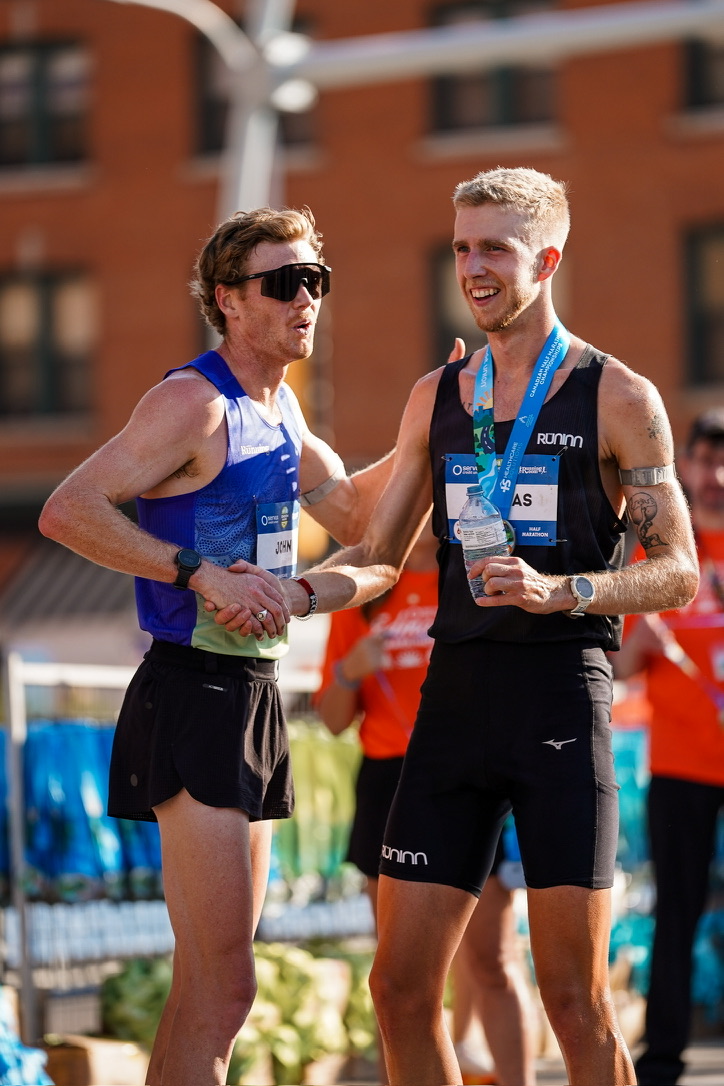
About Tom Nobbs
Running Coach. Professional Marathoner. Lifelong Student of the Sport.
Running has been part of my life for about as long as I can remember.
I grew up in Vancouver, BC, in a family where running was simply part of the routine. My dad competed at a high level in Australia before becoming a co-owner of The Runinn, an independent specialty running store, and both of my parents have been lifelong runners. I played plenty of other sports growing up, but running was the one that kept pulling me back.
What stuck with me wasn't only the racing. It was everything around it. Helping out at the store. Being around runners talking through injuries, shoes, workouts and races. Volunteering at events. Setting up courses. Watching people chase goals that mattered deeply to them, whether they were trying to win their age group, qualify for Boston, or simply finish.
I started competing young and eventually represented provincial teams and Canada at junior and senior Pan-American Cross-Country Championships. Later, I spent time in the NCAA system at the University of Washington before returning to Canada to race track and cross country for the UBC Thunderbirds.
Those environments exposed me to very different coaching styles, athletes and training philosophies. I saw different approaches to volume, threshold development, speed, strength, recovery and race preparation, and I started to understand that good coaching is rarely about committing blindly to one system.
Over time, one lesson became pretty obvious: there is no single perfect training philosophy. What matters is understanding the athlete in front of you, knowing what each piece of training is trying to accomplish, and being able to decide when a method fits, when it needs to be adapted, and when it simply doesn't belong in that athlete's program.
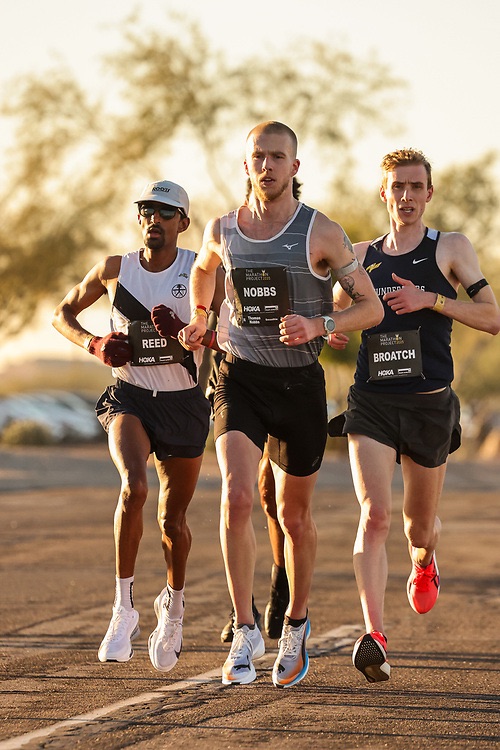
2:08:35, the 3rd fastest Canadian marathoner of all time.
How I Think About Coaching
I don't think good coaching is about designing the hardest workout and hoping an athlete will survive and it's also very much not about chasing the sexiest workouts you see on Strava and trying to replicate them yourself.
The goal of training and 'partnering' with a coach for your running career, is about understanding what kind of runner you are, what kinds of training you respond well to, where you currently have room to improve (what gaps and weaknesses we need to address) and what training patterns you can replicate and sustainably execute consistently over time.
That usually means developing your aerobic system first, improving threshold and running economy over time, building enough strength and durability to tolerate greater training load, and gradually making specific workouts more specific as your goal race approaches.
But physiology is only part of coaching.
Your job matters. Your family matters. Sleep matters. Injury history matters. The weather you train in matters. How you aced or failed your last Tuesday workout matters.
So does knowing WHY you're doing this in the first place.
One of the things I care most about as a coach is helping athletes find their own "why" in running.
Sometimes that is a race goal. Sometimes it is seeing what you're capable of, rebuilding confidence (in and outside of endurance sport), creating structure in your life, or simply having something meaningful to work toward.
Running has a funny way of extending beyond your training environment and creates positive momentum in other parts of your life.
The patience, discipline, confidence and ability to deal with discomfort that we build through our sport, tends to show up elsewhere too.
A theoretically perfect training plan that doesn't fit the athlete and doesn't 'excite them or challenge them in its design, isn't a very good training plan.
And what's the point of training if you never get to share the daily wins or losses with anyone?
That is why I prefer to coach the person rather than simply prescribe the program. That's why I work with a coach myself, and that's likely why you're reading this - because you crave accountability, or that next result, or feel lost in training and have no idea where to start
What I Believe
Consistency beats individual heroic workouts. Fitness comes from stacking good ('OK') weeks and months together, not from proving yourself in one off sessions.
Every workout should have a purpose. I want you to understand why we are doing something, what physiological function the session serves, what adaptation we are trying to create and what the workout should actually feel like.
Understanding the training matters. I share as much as I reasonably can about why your program is designed the way it is. My goal isn't for you to blindly complete workouts. I want you to gradually understand how the pieces fit together. BE A STUDENT and FAN OF THE SPORT.
Training should progress with you. Paces, mileage and workouts shouldn't remain fixed because a spreadsheet says they should and should adapt at the rate you can reasonably adjust to. Training changes as the variables of fitness, fatigue, life and race demands change. Life is chaotic, I get it.
Easy running needs to be easy enough, and hard days need to be hard enough. Not every run needs to demonstrate fitness. A lot of improvement comes from keeping low-intensity work genuinely controlled so we can absorb the important work, which in turn queues up your hard days. By polarizing the rollercoaster ride of hard and easy days, you will improve faster and stay healthy over time
The goal is to absorb training, not just complete it. Whether you're preparing for a 5K or a marathon, the work only matters if your body can adapt to it. Strength, recovery, fueling and sensible progression help us handle the right amount of training for your event and come back ready to benefit from the next session.
Specificity matters more as race day approaches. General aerobic development creates the foundation. Threshold, speed and eventually race-specific training teach you how to use it.
We train to race, not to train. Racing is an art. Workouts build fitness, but the whole point is learning how to express that fitness when it actually matters - reading a race, making decisions, responding to other people, knowing when to be patient and when to take a chance, and being willing to compete when the race stops feeling comfortable. I want athletes to become better racers, not just people who are really good at burying themselves in workouts.
Your reason for running matters. Goals change. PRs eventually stop being the only measurement that matters. Understanding what keeps you connected to the sport and your physical well being gives training a much stronger foundation than chasing numbers alone.
What Working With Me Looks Like
My coaching is individualized rather than built from a fixed template.
That can include:
- A personalized 1:1 running plan built around your goals, training history and available time
- Training adjusted as your fitness and life change
- Clear pace and effort guidance for every workout
- An explanation of the physiological purpose and intended feel of key sessions
- Feedback and discussion around workouts rather than simply uploading the next week (we can text/call about it or have live discussions about every workout through final surge on your exact GPS activity that just got uploaded)
- Race-specific preparation, pacing and fueling strategy
- Strength and core programming when appropriate
- Guidance around fueling, recovery and training habits
- Return-to-running and workload management after injury
- Regular communication and the ability to ask questions when something doesn't feel right
- Help understanding not only what you're doing, but why you're doing it
- Check in calls and strategy calls whenever you need
I want you to become a better runner while also becoming better at understanding your own running.
The ideal outcome isn't dependence on your coach. It is having somebody in your corner who can see the bigger picture while gradually teaching you to understand it too - oh and getting you faster with the best possible workouts that are made just for you.
Closing the Gap Between Elite Training and Your Training
One advantage of being both a professional runner and a coach is that I get to live inside high-performance sport every day. I also draw from 20 years of competing as a runner and my experiences training with and racing with Olympians, while having worked with highly accredited coaches in the NCAA, with Athletics Canada, and other accredited teams.
And I try to share that experience very openly with the athletes I coach.
I am transparent about my own training - the workouts I do, how they are structured, what my coach and I are trying to accomplish, how I fuel, how I recover, what we change when something isn't working, and which ideas actually seem to move the needle.
Not because my athletes should copy what I do.
Most shouldn't.
The useful part is understanding the principles underneath it.
There is an enormous amount of running information online now. Some of it is excellent. Some of it is marketing BS dressed up as physiology. Some of it is an interesting idea taken completely out of context because it makes a good Instagram reel.
Part of my job is helping athletes learn the difference.
I want the people I coach to have access to what I am learning from my own training, my coaches and the high-performance environments around me, while also understanding which parts actually matter for their own running.
You don't need every supplement, training trend or "secret" workout you see online.
You need to identify the relatively small number of things that consistently move the needle, then do those things well for a long time.
Coaching the Athlete in Front of Me
I coach first-time runners, experienced recreational athletes and highly competitive runners, but I don't think good coaching changes dramatically depending on how fast somebody is.
The details change.
The amount of running volume can change. The workouts change. Recovery requirements change. Goals certainly change.
BUT the attention to the individual never does.
I've coached athletes preparing for their first 5K, runners trying to finish their first marathon, Boston qualifiers, collegiate athletes and runners pursuing national-level performances.
Everybody deserves thoughtful coaching.
Some runners need help learning how to train hard enough. Others need a coach to simply tell them to stop overtraining.
Part of my job is figuring out which athlete I'm talking to and answering any question, no matter how small or big it is.
My Coaching Influences
My coaching has been shaped by both the coaches I have personally worked with and coaches whose work I have spent years studying.
I have a deep appreciation for Arthur Lydiard, Jack Daniels, Renato Canova, and coaches such as Nic Bideau, Brant Stachel, and Frank Gagliano have all influenced how I understand endurance development.
My own coach, Brant Stachel, continues to influence how I think about the relationship between good physiology and effective coaching.
I don't follow one system.
I try to understand the principles behind different training systems, determine why something works for a specific athlete, and then use what makes sense for the runner in front of me.
Coaching Experience
I have been involved in coaching for more than a decade, including:
- Coaching and volunteering with junior development athletes beginning at age 12
- Coaching high school athletes through the Vancouver Olympic Club
- Serving as Head Coach of the Thunderbirds Track and Field Club's East Vancouver division
- School outreach and youth running programs
- Coaching collegiate, recreational and competitive adult runners
- Individual online coaching across the 5K, 10K, half marathon and marathon
- Athletics Canada / NCCP coaching education
Today, the majority of my coaching is individualized online coaching with athletes across Canada, the United States and internationally.
As an Athlete
Recent racing highlights include:
2:08:35
Marathon - 17th overall, top Canadian, 2026 Chicago Marathon
2:09:25
Marathon - Winner and course record, 2026 McKirdy Micro Marathon
2nd
2026 Canadian Half Marathon Championships
1:03:06
Half Marathon - 2025 Project 13.1
28:48
Road 10K
11th
2025 Marathon Project Pro Race
5th
2024 Canadian Marathon Championships
Canada
Representative in international cross-country competition
Personal bests:
2:08:35
Marathon
1:03:06
Half Marathon
28:48
Road 10K
29:16
10,000m
14:12
5,000m
8:15
3,000m
The Bigger Picture
I still love running for essentially the same reason I did when I was younger.
It gives you an unusually honest way to work on yourself.
Some days that means running faster than you ever have. Sometimes it means learning to be patient. Sometimes it means changing your plans you were deadset on. And sometimes it just means dealing with the mile you're currently in rather than worrying about dozens more that come after it.
One of the most valuable things training can give us is a better understanding of why we choose difficult to pursue difficult things in the first place.
A race gives you a finish line. But the more interesting part is often seeing how you changed as a person on the way there.
That's a large part of what keeps me interested in coaching.
There is always another layer to figure out.
And there is something pretty special about helping another runner figure it out for themselves.
Running is simply a vehicle for self-improvement and teaches you to deal with the challenges of the mile you're in.